Showing posts with label collecting. Show all posts
Friday, June 7, 2013
On Antique/Vintage/Modern Retail Theater: What are you really paying for?
Retail theater. I love the term. It is most often used in fashion, specifically in discussing one method by which stores like T.J.Maxx (or T.K.Maxx in the UK) can sell the same items as department stores for less. The department stores invest money in retail theater - window displays, stylist marketing, personal shoppers, designer sections, etc. whereas T.J. Maxx is lucky if they have sorted everything correctly by gender.
It is useful to think of retail theater in antique shopping as well. The cheapest finds are always in the places that are not investing in decor - thrift stores and yard sales. The average auction may also find itself grouped in this category (more on auctions in a later post). These cheap spots are also the ones where you have to have the most patience and enjoy a game of chance. More often then not you will strike out if you are not open to finding more than one very particular item.
The most expensive spots? Galleries and high-end shops. What distinguishes these from the mid-range shops? They are considerate of staging, marketing and personal relationships. The curators and proprietors of these establishments take pride in themselves and their collection. They won't be displaying a signed Picasso print behind a beat-up Walmart frame. The price they charge will reflect the effort it took them to source it, acquire it, clean it, hang it and keep it well displayed. (I will conveniently ignore the complex and inscrutable algorithm that considers past sales, the market, condition, rarity, overall aesthetics, etc.)
Why does this matter to you? After all, I am not advocating that everyone avoid galleries to exclusively shop at thrift stores. I for one, plan to eventually be in a position where I do not have the time to search low and high to source my collection, but will (fortunately) have the funds to acquire them in the most convenient (and best curated) locations. It is worth noting that I do not expect to reach this position through the antique industry.
Consideration of the premium cost of retail theater is key to considering your own decorating budget. How much is your time worth? (No, seriously. If you were at your computer, on the phone with a client, in the OR, on the stage or anywhere else instead of picking through items in someone's garage, how much would you be making?) If you are in a position where you have the luxury of time on your side, you may benefit by learning to shop without the theatrics.
Are you willing to pay extra for a the perfect convenient find or do you enjoy the thrill of the hunt?
Sunday, June 10, 2012
The Magic Maids: A Cautionary Tale
Have you encountered a jewelry dealer whose prices seem so
low they are almost too good to be true? Or one whose supply seems to increase
dramatically overnight but cannot disclose the provenance of any piece? Do you wonder how “Cash for Gold” operations
pop up everywhere and then stay in business?
The (unfortunate) answer: theft.
Theft is not just in the news, in the sketchy areas of town, or a
plotline of Law and Order – it happens in antique malls, estate sales and even
your own home. Need further evidence?
Consider my routine sighting of the Magical Maids:
Almost every day (at lunch or in the evening), a van opens
in the parking lot of our antique mall.
Out pop several Maids, with conspicuously bulging aprons. These women enter the mall and go directly to
the jewelry dealer. Have they become
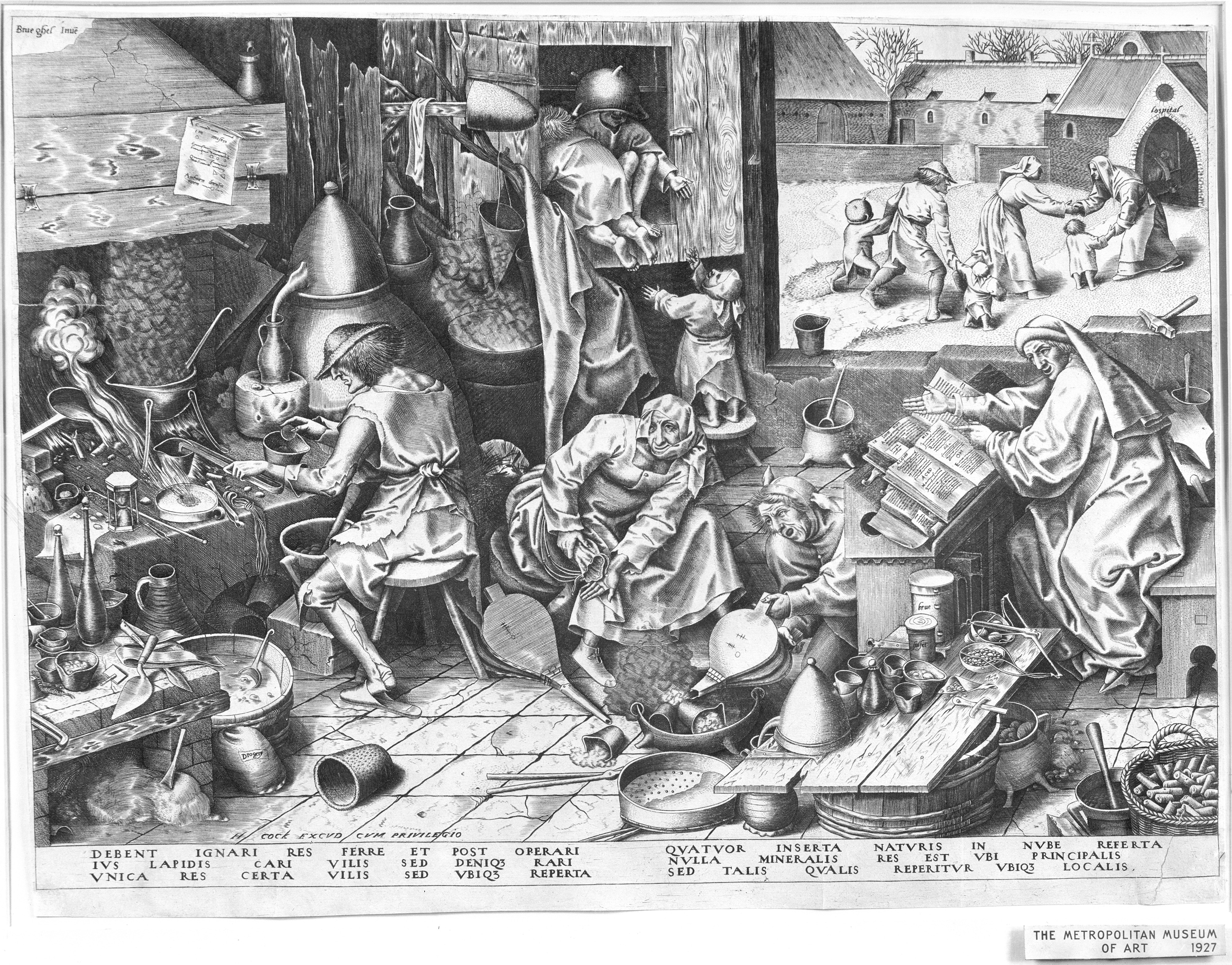
alchemists on the side? Do they have trust funds but satisfy their obsessive
need for cleanliness with a side job?
Unfortunately (for them and us), the answer to those (admittedly absurd)
questions is no.
| The Alchemist. Engraving by Peter Bruegel the Elder, ca. 1525-1569. Photo from the Metropolitan Museum of Art. |
The jewelry dealer does not ask questions, does not log
descriptions of the pieces being purchased and does not pay much. Yet the Maids (and other Unexpected Alchemists)
keep coming back. It is known to all in the mall that the Magical Maids are
selling the dealer gold, silver and gemstones.
It should also be known by all in the mall that they are not coming
across these pieces in periodic cleanouts of their own jewelry boxes.
While it always stood out to me, and certainly put the
integrity of the jewelry dealer in question, it was only recently that I
learned the mall has been a front for major gold buying for years. At the most reputable gold buyer in the area,
a description identical to the one written above yielded an immediate “I know
where your mall is.” Indeed, all it took
was a county name and a high volume of questionable precious metal transactions
for the expert to identify the business.
In fact, he had been aware of the questionable (and illegal) movement of
gold through the mall even under several previous owners, and had personally turned
down one prior owner’s large quantities of Magic gold.
What can you take from this true story:
1)
Check your jewelry boxes and put rarely used
expensive and/or family pieces in a safe or safety deposit box. There are people welcomed into your home who
have sticky fingers – some may be employed by you, some may not be.
2)
If buying jewelry (or any high-end item) at a
shop, ask questions about that piece and the dealer’s sources. The last thing you want is to buy a “hot”
piece of jewelry that is later tracked down by the police and reclaimed.
3)
If you are having your own estate sale, secure
any jewelry of worth in a case or out of sight.
Show it to prospective buyers one at a time. Take it to several established and accredited
jewelers to learn about it, and get price quotes. If you consider selling it yourself online,
beware of the potential for returns -there are horror stories of mailing out
genuine stones and receiving a return in which the stones have been replaced by
CZ and lab-generated fakes.
4)
Final disclaimer: I have nothing against maids,
nor am I accusing all maids of being thieves, or of being of such questionable
moral character that theft would be a possibility. This tale was meant to illustrate one
instance of “things the dealer doesn’t want you to know”, the need for
collectors and heirs to secure (and insure) their collections, and the
importance of asking questions about where a piece came from – and not just
because you happen to be a history buff.
Thursday, June 7, 2012
Develop Your Eye
| Image from: imamuseum.org |
Are you on a tight budget but love
decorating? Do you read Elle Decor and cringe (or just ignore)
the cost to recreate a room piece by piece? Have you stumbled upon
vintage/thrift/décor blogs whose bargain finds – and their impressive
subsequent repurposing - boggle your mind?
Finding a great decor piece at a
bargain requires luck, a good eye, and persistence. Thrift stores (and some vintage/antique
shops) can not tell you whether an item is MCM or MCM-like from Pier 1.
If you would like to find the
bargains others share, develop your eye so that you can spot the treasure
amidst the junk. This applies whether
you are thrifting for clothing, furniture or knickknacks. Just as you would need to know high-end label
names or the markers of high-end clothing construction, you need to know the
signs of high-quality furniture, art glass, lighting and silver. The best way to do this is to learn from
those with a good eye – established dealers.
Transition from browsing online to browsing in antique stores and
museums.
As the daughter of a dealer, I can
tell you there are two ways to approach this technique. The first is to latch on to the first
knowledgeable dealer you come across and barrage them with questions. The second is to visit numerous shops,
markets and museums and absorb tidbits of knowledge over time. I cannot recommend the second technique
strongly enough. Not only is
interrogating a dealer mildly obnoxious, a good eye cannot develop instantly
(even if instantly consists of a hour-long Q&A). Mastering the details of the construction of
a Phyfe-style piece in one dealer’s store is a great start, but it does not
mean you know what they know or will be able to recognize Gustav Stickley from
Stickley when you come across a piece in an auction.
As you are developing your eye,
where should you treasure hunt?
Auctions, thrift/secondhand stores, flea markets and even antique
stores. For tips specific to thrift stores,
I really recommend the post on Apartment Therapy http://www.apartmenttherapy.com/how-to-a-few-tips-for-thriftin-151146
It reinforces the need to spot
quality, the need for persistence (as evidenced by repeat visits) and the
importance of considering not just what the item is but what it could be. If you are planning on decorating a room,
either from scratch or a re-do, keep a running list (in your head or on your
smartphone) of your needs. Spotting the
treasures is a great skill, but it only benefits you in the long run if you
spot a treasure you actually need. Last
week, Madame Trent and I found an Ethan Allen (not Duncan Phyfe or of any
significant age, but solid cherry and a good look) small dining table for $30
(free of major condition issues). This was a steal for someone (the someone who
bought it before Madame Trent could double back and invent a pressing need for
it), but our only use for such a table would be to stage a few of our hundreds
of antique chairs.
Before you become
overwhelmed by the selection in a store, you should create your list of items
to look for – a bookcase for the office, a table for the entryway, a pair of
wingback chairs, mercury glass gazing balls, a pair of lamps to bring a pop of color to your
server a la last month’s Elle Décor --- whatever inspires you.
Saturday, April 21, 2012
Thrift Stores: The Next Frontier for Museum Acquisitions or a Dumping Ground for Forgeries?
| Daniel Buren "La Coupure" Installation Art at Musée Picasso, Paris. Photo by Nell. |
At the time of its sale in 2010, an original Picasso painting set a world record for a work of art at auction when it sold for $106,000,000 (yes, that is $106 MILLION dollars). In the past few weeks, I have heard several thrift veterans, to the awe of the news anchors, tout their best finds at thrift stores – signed Picasso prints. Authentic Picasso PRINTS are valued at up to $10,000 (depending on the size of the edition, the image, and the state of the art world).
I have yet to hear about anyone finding an original Picasso painting. However, I have witnessed my mother, Madame Trent, on quite a few occasions as she has had to diplomatically caution yet another New Picasso Print Owner who demands on-the-spot appraisals via his iPhone. Picasso prints are by their very nature more common than Picasso paintings. However, fake Picasso prints are even more common. “It has a signature” or “It looks just like the pictures of his signature” do not immediately equal “It was printed and signed by Picasso.” A New Picasso Print Owner thinks he has struck gold. However, internet searches do not produce experts nor do they qualify as authentication. Not to mention, there are works by artists without the name recognition of Picasso (but could still be worth anywhere from a few hundred to ten thousand dollars) that have likely been passed over during the time the Picasso Print Owner was not finding Picassos left and right.
A word of caution: These days it is easier than ever for art forgers to produce a heliogravure of a signed print. The pencil signature might be real and it might be an actual signed Picasso print, but it may just be a printed photograph of an actual signature (or a forged signature in pencil). (Heliogravures are, simply put, photocopies). A lithograph implies an artist hand drew his image onto a plate (metal or stone), inked it, put paper on the plate and applied pressure in a press. The term “print” encompasses every type of image reproduction – from a hand-pressed image to a commercial printer’s output. An "original print" - when the term is used accurately - implies something more specific.
What brought out my inner (self-educated) art historian?
Lately I’ve heard several instances of Picasso finds while thrifting, including one from Lara Spencer, of GMA. While anything is possible, these tales should not send you out on an immediate treasure hunt or cause you to doubt your own art finds. Instead of hunting only for works by famous artists, look for art that you like. While you may never find an original Picasso (or van Gogh, or Monet, or Rembrandt, etc.) in a thrift store, you may find a large painting by a local or even nationally known artist. Thrift stores often price prints and paintings at nearly the same price – it can be tricky to tell them apart – and pricing is often by size and not medium, subject, condition or artist. With a smartphone at hand, you may be able to quickly discover if the “artist” is known, but searching every name on every piece of art will drag out an otherwise quick swing through a thrift store.
Never plan to invest in art for reselling until you know about it – go to museums, go to art and antique shops, read about famous artists and techniques. A mass-produced reproduction of a Picasso might be perfect for decorating your office, but it does not have much resale value (large framed prints and posters can go for around $50 to the right person). The major tip I have for telling prints from originals (in this case, I am referring to watercolors and pen and inks which have no paint texture to distinguish them) is to look for the “pixels” in the image. If you hold a watercolor print up close, it will appear to belong to the micro-Pointillist movement (which is not a real art term). In other words, there will be little dots instead of a consistent sweep of color.
So, if shopping for art, what should you look for if not discarded masterpieces?
Whether for yourself or for resale, ask yourself these questions:
- Is it original? (One of a kind or an authentic signed and numbered print)?
- Is it good? Do you like it?
- How much is it?
- Do you know anything about the artist?
- Is there paint loss, foxing, or other damage to the canvas, paper, mat or frame?
- Could you sit and look at it over and over again?
| One of Monet's masterpieces in Musée de l'Orangerie, Paris. Photo by Nell. |
While I love the work of Monet in museums, particularly Musée de l’Orangerie and Musée Marmottan in Paris, my own collection consists of smaller scale pen and ink drawings and signed limited edition prints, both types executed by artists of significantly less fame than Monsieur Monet. And yet, I have paid less for these eye-catching originals than for a pixelated poster at either of the aforementioned museums. If you can not put a real Monet on your wall, aim for another professional artist – you might even find the next incredibly talented artist of our time.
Subscribe to:
Posts (Atom)